About this game
Play Couples Charades together
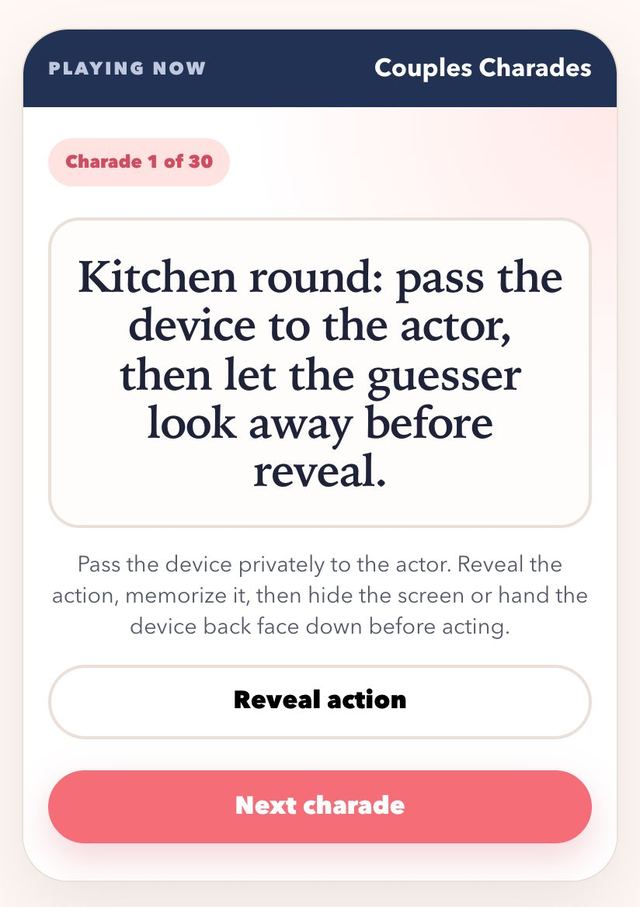
Couples Charades turns familiar moments into a fast guessing game for two. Each round first shows a handoff cue, so the guesser can look away while the actor privately reveals a scene. No props, score sheet, or acting experience is needed—commit to the movement, laugh at the wrong guesses, and swap roles after every card.
How to play Couples Charades
- 01
Choose the first actor and make sure the other partner looks away from the screen.
- 02
Pass the device to the actor, reveal the action, and hide the screen before starting.
- 03
Act silently while the guesser names as many possibilities as needed.
- 04
Advance to the next card and switch roles after every successful guess or pass.
Why couples like it
- Physical clues create easy laughter without asking either partner to share private information.
- Alternating roles gives both people equal time to perform and guess.
- Short, familiar scenes make the game approachable even for shy players.
All 30 acting prompts
Spoiler alert: this list shows the hidden scenes. Read it for ideas, or play the deck above first.
- 01
Trying to open a stubborn jar
- 02
Hitting snooze on three imaginary alarms
- 03
Dragging an overpacked suitcase through an airport
- 04
Teaching a puppy to sit
- 05
Walking against a powerful wind
- 06
Choosing an outfit and rejecting every option
- 07
Conducting a dramatic orchestra
- 08
Vacuuming around a sleeping cat
- 09
Flipping a pancake that sticks to the ceiling
- 10
Taking ten selfies to find the perfect angle
- 11
Following a workout video that moves too fast
- 12
Watching a scary movie from behind a pillow
- 13
Pushing a shopping cart with one wobbly wheel
- 14
Putting sunscreen on an unreachable spot
- 15
Searching the sofa for a missing phone
- 16
Opening a surprise gift and pretending not to know what it is
- 17
Trying to eat an extremely long noodle politely
- 18
Watering plants with a hose that suddenly sprays back
- 19
Learning a dance step from a mirrored video
- 20
Assembling furniture with confusing instructions
- 21
Walking carefully across an icy sidewalk
- 22
Carrying two hot drinks through a crowded room
- 23
Folding a fitted sheet that refuses to cooperate
- 24
Setting up a tent as it keeps collapsing
- 25
Celebrating a board-game win in slow motion
- 26
Opening an umbrella that turns inside out
- 27
Trying to hear a call with terrible reception
- 28
Decorating a cake while the icing keeps sliding off
- 29
Pretending to be a statue when someone walks past
- 30
Catching an imaginary bouquet in a crowded room
Charades rule variations for two
- Timed rounds: the actor has sixty seconds, and each correct guess earns one point.
- Slow motion: act every scene as if the room were underwater, which makes small gestures easier to read.
- Mirror round: the guesser copies the actor's movements while guessing out loud.
- Genre swap: perform the same scene as a silent movie star, a dramatic opera singer, or a nature documentary.
How to act a scene so your partner can guess it
Start with the setting before the action. Pointing at the floor, shivering, or fanning yourself tells your partner where you are, and that narrows a long list of possibilities quickly. Then show the object you are handling by miming its size and weight, since a heavy suitcase and an empty paper cup move very differently.
Exaggerate the problem in the scene. Most of the actions in this deck involve something going slightly wrong, such as a stubborn jar or a wobbly cart wheel, so the humor lives in the struggle. Let your face react first, then your body, and you will get guesses much faster than if you act it out neutrally.
Making charades fair and fun for a pair
With only two players, one person is always acting and the other is always guessing, so the pace can feel lopsided. Switch roles after every card, count a close guess as correct, and decide in advance how many passes each person gets. A pass is not a failure; it keeps the game moving when a card does not suit the moment.
If you want a few more rounds beyond the 30 scenes, write your own on small slips of paper using real moments from your week, then mix them into the pile. Personal scenes, like the way one of you hunts for keys, usually get the biggest laughs.
Make the next round better
- Agree on a one-minute limit if you want a quicker, more competitive round.
- Use facial expressions and imaginary objects, but do not mouth the answer.
- If a card feels awkward, pass immediately and keep the game moving.
Couples Charades FAQ
How do two people play charades on one device?
The guesser looks away, the actor privately reveals one action, then the device is placed face down while the silent performance begins.
Can we skip a difficult charade?
Yes. Treat any card as optional, advance immediately, and swap roles as usual so one hard scene never stalls the game.
Do these charades require props?
No. Every action is designed for gestures, facial expressions, and imaginary objects, although safe household props are fine if both players want them.